Search Results - Toussaint Louverture, 1743-1803
Toussaint Louverture
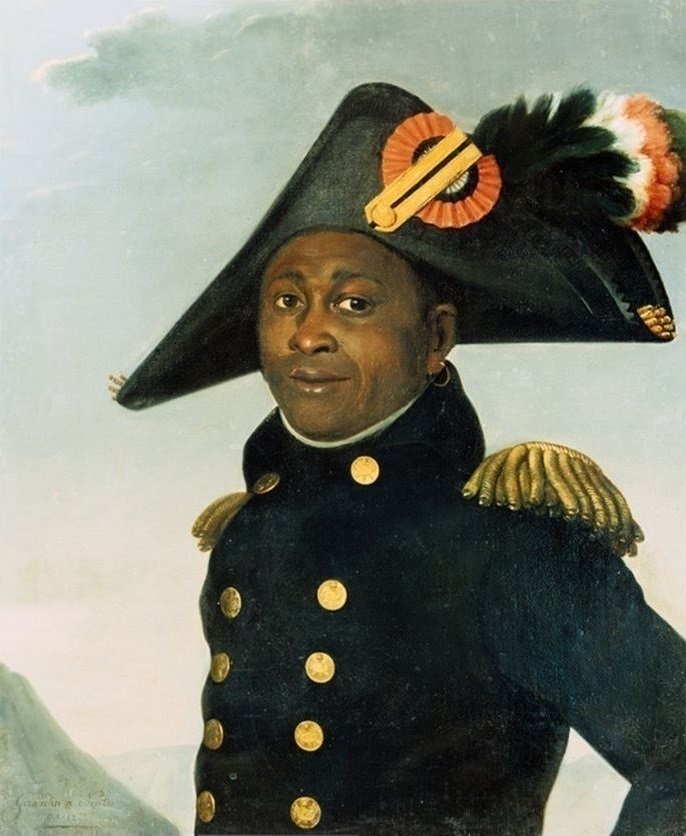 François-Dominique Toussaint Louverture ( , ; 20 May 1743 – 7 April 1803), also known as '''Toussaint L'Ouverture or Toussaint Bréda''', was a Haitian general and the most prominent leader of the Haitian Revolution. During his life, Louverture first fought and allied with Spanish forces against Saint-Domingue Royalists, then joined with Republican France, becoming Governor-General-for-life of Saint-Domingue, and lastly fought against Bonaparte's republican troops. As a revolutionary leader, Louverture displayed military and political acumen that helped transform the fledgling slave rebellion into a revolutionary movement. Along with Jean-Jacques Dessalines, Louverture is now known as one of the "Fathers of Haiti".
Toussaint Louverture was born as a slave in the French colony of Saint-Domingue, now known as Haiti. He was a devout Catholic, and was manumitted as an ''affranchi'' (ex-slave) before the French Revolution, identifying as a Creole for the greater part of his life. During his time as an ''affranchi'', he became a salaried employee, an overseer of his former master's plantation, and later became a wealthy slave owner himself; Toussaint Louverture owned several coffee plantations at Petit Cormier, Grande Rivière, and Ennery. At the start of the Haitian revolution he was nearly 50 years old and began his military career as a lieutenant to Georges Biassou, a leader of the preliminary 1791 slave revolt. Initially allied with the Spaniards of neighboring Santo Domingo, Louverture switched his allegiance to the French when the new Republican government moved to abolish slavery in its colonies. As leader of the Haitian Revolution, Louverture gradually established control over the whole island and used his political and military influence to gain dominance over his rivals.
Throughout his years in power, he worked to balance the economy and security of Saint-Domingue. Worried about the economy, which had stalled, he restored the plantation system using paid labor; negotiated trade agreements with the United Kingdom and the United States and maintained a large and well-trained army. Louverture eventually seized power across Saint-Domingue, established his own system of government, and promulgated his own colonial constitution in 1801 that named him as Governor-General for Life, which challenged Napoleon Bonaparte's authority.
In 1802, Louverture was invited to a parley by French Divisional General Jean-Baptiste Brunet, but was arrested upon his arrival. He was deported to France and jailed at the Fort de Joux. He died in 1803. Although Louverture died before the final and most violent stage of the Haitian Revolution, his achievements set the grounds for the Haitian army's final victory. The Haitian Revolution continued under Louverture's lieutenant, Jean-Jacques Dessalines, who led the Haitian forces to victory over the French army, which was also being ravaged by yellow fever. The final major battle was fought at the Vertières on November 18, 1803. Saint-Domingue finally declared its independence from France on 1 January 1804, where the African slaves have established a new sovereign state named Haiti, after the indigenous Taíno name for the western mountainous side of the island "Ayiti". Following the independence from French colonial rule, Haiti was the first independent black republic in the Americas and the second independent nation in the Western Hemisphere, after the United States. In 1825, after twenty one years of Haiti's independence, France recognized the Haitian sovereignty, but only after forcing the new nation to agree to pay an indemnity of 150 million gold francs. President Abraham Lincoln officially recognized Haiti in 1862, during the American Civil War; the decision marked a significant reversal of decades of U.S. policy and was connected to the long-term legacy of Toussaint Louverture and the Haitian Revolution. Provided by Wikipedia
-
1